News Story
Aerospace Department Welcomes Assistant Professor Harsh Bhundiya

Assistant Professor Harsh Bhundiya
Some of the structures envisioned for future space missions may never fit inside of a rocket.
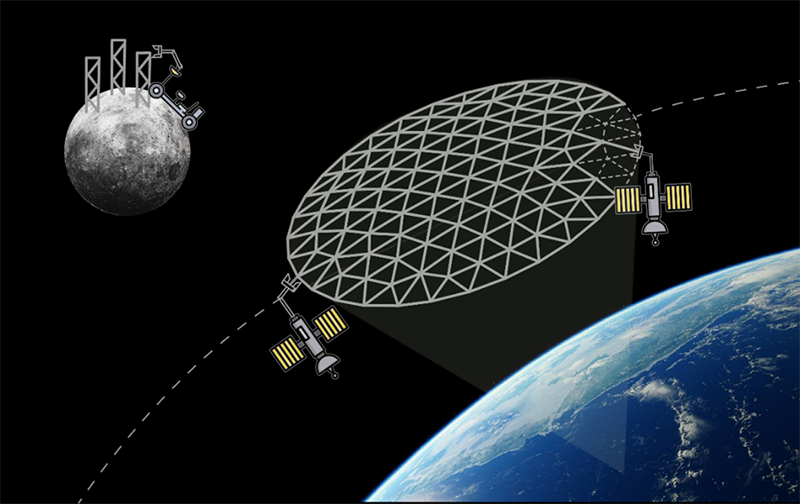
Large space telescopes, communications arrays, and infrastructure on the Moon and Mars may need to be assembled, or even manufactured, once they reach their destination. For new faculty member Harsh Bhundiya, those challenges form the backbone of his interdisciplinary research to enable the next generation of space structures.
Bhundiya, who joined the University of Maryland Department of Aerospace Engineering as an assistant professor in August 2026, is exploring how lightweight structures, low-power deformation processes, and robotic systems could make construction beyond Earth practical.
Today, most spacecraft are designed to survive launch in a compact form and deploy once they reach orbit. But missions increasingly require large structures that exceed what can reasonably be stowed into a launch vehicle. This shifts the engineering problem from designing spacecraft to survive launch to designing spacecraft to constructing systems in orbit and on planetary surfaces.
That could mean assembling large truss structures piece by piece, developing new material feedstocks, coordinating multiple robotic systems, and eventually developing autonomous space-based factories.
Solving those individual problems, however, is only part of Bhundiya's focus. His research also considers mission planning — how long construction will take given spacecraft constraints, how construction will affect the spacecraft's motion and attitude, and how subsystems like communications will remain operational throughout.
Precision presents another challenge. With large, lightweight structures, assembly errors can compound as construction progresses. Bhundiya is exploring ways to measure structures in real time to guide subsequent steps in an adaptive approach: build, measure, adjust, and continue.
“I am really motivated by ‘science fiction’ challenges,” said Bhundiya, “And I’m privileged to be in a position to help solve them.”
At Maryland, Bhundiya leads the newly established Space Structures and Robotic Construction (SPARC) Lab.
Bhundiya received a Ph.D. in Aeronautical and Astronautical Engineering from the Massachusetts Institute of Technology, and a B.S. in Mechanical Engineering from the California Institute of Technology.
Right: A vision for in-space construction of large antennas on orbit and infrastructure on the Moon and beyond.
Published September 22, 2026
Related Stories
Stories / June 25, 2026
Aircraft May Refuel Themselves - With Help From AI

Stories / February 24, 2026
MATRIX Lab Advancing Smarter, More Affordable Autonomy

Stories / January 8, 2026
MATRIX Faculty to Present at International Conference
Stories / April 14, 2025
MATRIX-Affiliated Faculty Solving Tomorrow's Challenges Today
Stories / February 28, 2025
MATRIX Lab Hiring Research Development Director
Stories / November 19, 2024
Department Welcomes New Faculty Member Tam Nguyen

Stories / October 25, 2024
Wereley, Choi Honored with Outstanding Technical Paper Award at...
Stories / December 21, 2023
Six Clark School Faculty Receive 2024 DURIP Awards
Stories / February 16, 2023
Maryland Engineers Awarded Grants to Address Humanity's Grand...
Stories / September 28, 2026
Searching for ET—One Particle at a Time